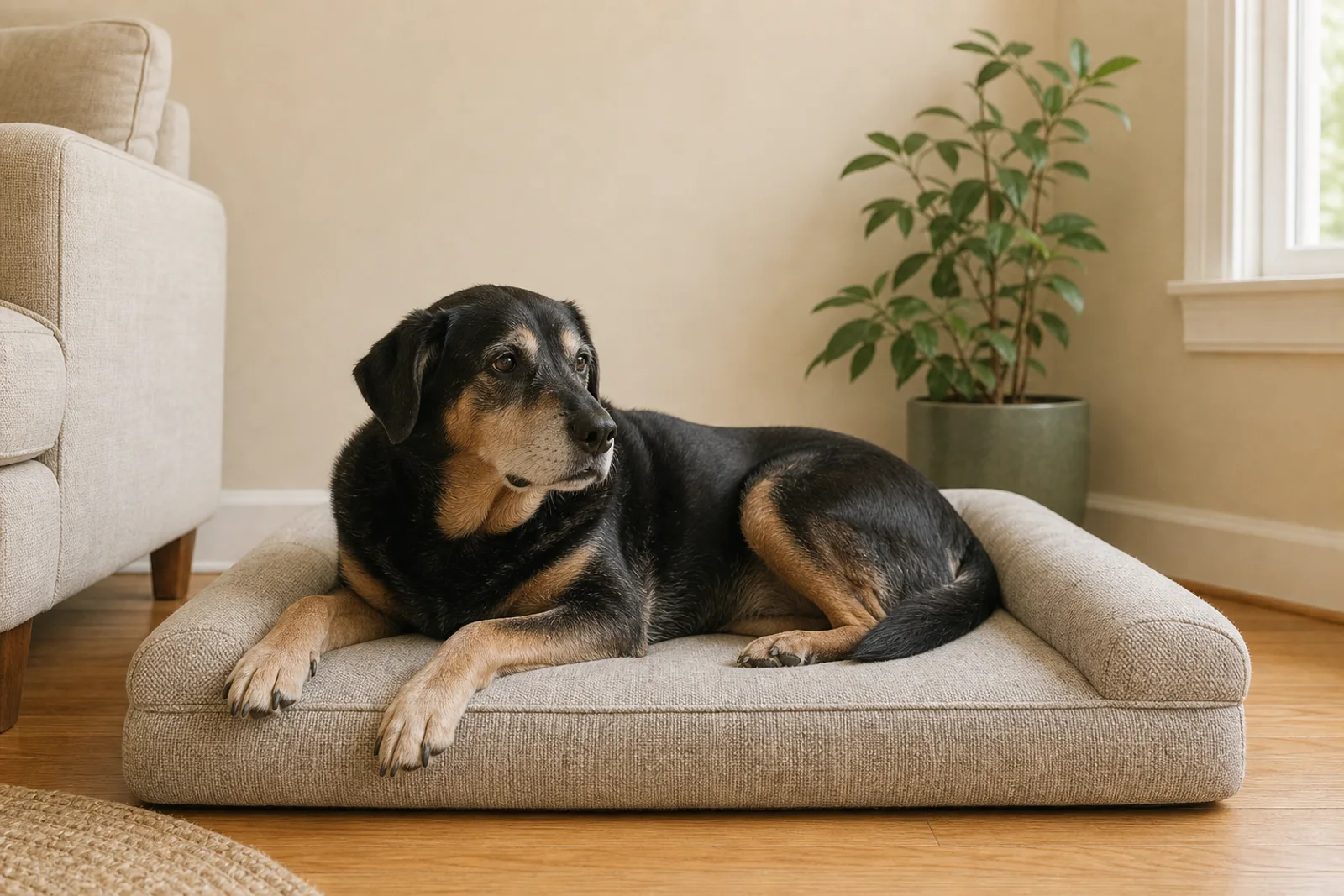
A good dog bed gives your dog enough room, steady support, and a surface you can keep clean. The right shape depends on your dog's sleep pose and the room. Easy entry matters too.
Orthopedic support matters most when a heavy dog sinks through thin fill or a dog has trouble getting up. Yet “orthopedic” on a tag does not prove that a bed will ease pain. Foam type, thickness, access, traction, and care directions tell you much more.
Use these picks as a shortlist, then confirm the selected size, care label, replacement parts, and written warranty before buying.
Dog beds at a glance
| Pick | Best for | What you can wash |
|---|---|---|
| Barker Beds Original Orthopedic | Large dogs that need deep, firm foam | Removable cover |
| Orvis RecoveryZone Couch | Curlers and leaners; premium house bed | Removable cover |
| K9 Ballistics Tough Ripstop Pillow | Diggers and scratchers who do not eat bedding | Removable cover |
| K&H Original Pet Cot | Warm rooms, porches, and damp ground | Removable mesh cover |
| Ruggable Woven Bolster | Small and medium dogs; easy style changes | Two outer covers |
| Kurgo Loft Wander | Car trips, hotels, and casual camping | Whole bed, gentle cycle |
| FurHaven Ultra Plush Luxe Lounger | Low entry and lower-cost solid foam | Removable cover |
Before you buy, measure both your dog and the open floor space. A bolstered bed may lose a foot of usable width to its sides. A thick mattress may also be too tall for a dog with weak legs, even when the foam feels supportive.
Types of dog beds
Dog beds fall into a few useful groups. The shape is not just a style choice. It changes the sleep area, entry height, warmth, and cleaning job.
Bolster beds
A bolster bed has one or more raised sides. Those edges give a dog a place to lean and can make the bed feel like a nest.
Bolsters work well for dogs that curl up or sleep against a sofa arm. An open front is easier to enter than a full ring. Measure the flat center, not just the full bed.
Pillow and flat beds
Pillow beds use loose fiber or shredded foam, so a dog can settle into a hollow. A flat foam mattress stays more level.
A pillow suits a light dog or one that loves to nest. A level slab often suits a heavy sprawler because fill cannot shift to the edges.
Orthopedic memory-foam beds
Most beds sold as orthopedic use memory foam, standard polyurethane foam, or both. Memory foam shapes around the body. A firmer base helps stop the dog from reaching the floor.
These beds can suit large and older dogs. Yet a high foam block can be hard to step onto. A gait change, joint pain, or trouble rising calls for a vet exam, not just a new mattress.
Elevated and cot-style beds
An elevated bed stretches fabric across a frame. Air moves below, and the dog stays off wet or dirty ground.
Cots work well on a porch, in a warm room, or as a “place” station. They lack deep padding, and the raised edge may challenge weak legs.
Travel and crate beds
A travel bed folds or rolls into a small bundle. It trades thick support for low weight and easy storage.
A crate pad must fit without bunching near the door or divider. Do not leave soft bedding with a dog that tears and swallows it.
Orthopedic support: what the word can and cannot tell you
“Orthopedic” is a loose marketing label in dog beds. It is not a regulated support grade or proof of pain relief. In an independent home-test guide to orthopedic dog beds, textile experts make the same basic point: the category has no strict definition.
Look under the label. Memory foam can spread pressure, but a thin layer may bottom out. Latex is springy and quick to rebound. Standard polyfoam often forms a firm base. Egg-crate foam uses less material at its peaks, while shredded foam shifts as the dog turns.
Density is not firmness. Density tells how much material fills a set space. Firmness tells how hard the foam is to press. Dense foam can still feel soft. Density can hint at wear, but most dog-bed makers do not give a number you can compare.
So check thickness, layers, written terms, and owner reports. A weak six-inch fill may offer less support than a firm four-inch base. A hand press also cannot copy the load from a 100-pound dog.
Owner reports about easier rising remain anecdotes. Medicine, weight, exercise, flooring, and disease can all change mobility.
1. Barker Beds Original Orthopedic: Best deep support for large dogs
The Barker Beds Original is built around a seven-inch foam block. It uses a two-inch base, a three-inch support layer, and a two-inch comfort layer. That is much deeper than a common three-inch dog mattress.
The size range starts large. The large is 48 by 30 inches, the XL is 52 by 36, and the giant is 60 by 48. That broad deck gives a big dog room to stretch. It also takes up a large part of a small room. The Headrest version adds one raised edge, while the Sleek version keeps the whole surface open.
The current Barker Beds product terms allow a cold wash for the cover. The foam has a 10-year no-flatten promise tied to keeping at least 90% of its shape and support. Fabric, chewing, accidents, and misuse are not covered. The sleep trial has donation and return rules, so read them before opening the foam.
A University of Pennsylvania team ran a single-arm pilot with 40 large dogs that had osteoarthritis. Big Barker funded or supplied the bed used in the study. Owners reported lower pain and stiffness scores after 38 nights, and some collar monitors showed less night movement. With no control-bed group, the study does not prove that every dog will improve.
Long-term owner reports often praise the flat, firm surface. Others note seam wear, a slow adjustment to the firm feel, or a dog that still picks the floor.
The seven-inch step is the main mobility drawback. A large dog may need deep foam yet struggle to lift a foot that high. Ask your vet or rehab team what entry height is safe.
2. Orvis RecoveryZone Couch: Best premium bolster bed
The Orvis RecoveryZone Couch pairs a four-inch medium-density polyfoam base with a one-inch Serene Foam top. Three solid-foam bolsters form a couch shape. The front stays open, so the dog does not have to climb over an edge.
This build suits a dog that leans hard into a side. Solid bolsters should stay more steady than loose fill. Orvis says the top layer spreads pressure and lets air move. Its recovery and temperature language is a maker claim, not a medical result.
The bed has a water-resistant liner and a quilted polyester cover. The cover zips off for machine washing. The foam does not go in the washer. That separation is useful after muddy paws, but liquid can still enter through an open zipper or damaged liner.
Size by the inner deck. The small is 32 by 22 inches outside, but its sleep area is only 21 by 16.5. The large measures 44.5 by 30.5 outside and 32 by 24 inside. A long dog that looks right for the outside size may hang over the center.
Owner discussions often praise Orvis covers after many washes. Many reports cover older models, so they cannot promise the same life for this core. The RecoveryZone also arrives compressed and needs assembly.
The main limit is cost. It makes sense only if your dog uses bolsters and you value the liner, open front, and finished cover. A plain lounger gives more sleep area for less.
3. K9 Ballistics Tough Ripstop Rectangle Pillow: Best for diggers and scratchers
The K9 Ballistics Tough Ripstop Pillow is softer than the first two beds. Its mattress uses shredded polyurethane foam in sewn channels. A dog can nest into the fill, while the channels aim to stop all of it from sliding to one end.
The 1200-denier ripstop cover has water-resistant backing, a hidden zipper, and a non-skid base. The liner also uses ripstop. Seams can still leak.
The maker gives unusually plain limits. It rates this bed 6 out of 10 for chewing and says it is for light or mild chewers. It warns against leaving it with a heavy chewer or a dog that destroys bedding when alone. Swallowed foam can block the gut and lead to an emergency.
Five sizes run from a three-inch small to five-inch medium through XXL beds. The current size chart lists 28 by 21 inches for small and 68 by 40 for XXL. The maker suggests measuring nose to tail base and adding 10 inches. That is a good start for a sprawler, but measure the dog's actual sleep pose too.
The outer cover removes, machine washes cold, and must air dry. The mattress liner does not come off. If urine reaches the shredded foam, a clean cover will not solve the odor. For frequent accidents, choose a sealed liner or a bed with a washable core.
Owner reports split. Some diggers get far more life from this fabric than plush. Other dogs open a seam or corner fast. The 120-day promise gives one replacement cover, not a new mattress or endless covers.
Soft fill is less stable than a level slab. A dog that struggles to rise may need firm foam that does not shift under the paws.
4. K&H Original Pet Cot: Best elevated bed
The K&H Original Pet Cot holds a breathable mesh panel across a metal frame. Most sizes sit seven inches above the ground. XL and jumbo beds sit nine inches high.
Air can move over and under the dog's body. The mesh also keeps the dog away from damp grass or a hot deck. That can feel better in warm weather, but airflow does not lower a dog's body temperature on its own. Shade, water, rest, and safe air temperatures still matter.
There are five sizes. The medium is 25 by 32 inches, the large is 30 by 42, and the XL is 32 by 50. K&H lists a 200-pound load limit for small through large and 300 pounds for XL and jumbo. Those limits show frame capacity, not the right fit. A 70-pound long dog can still need the XL for body length.
The cover slips over the frame, so there is no loose center strap. It removes for a cold gentle wash and line dry. You can also hose it off. Replacement covers are sold on their own. That keeps a sound frame in use when sun, nails, or time wear the fabric.
Owner reports praise quick cleaning and easy sweeping below. Complaints include tight first assembly, sag, and seams worn by outdoor use. Sharp nails and full sun will test any mesh.
This is not an orthopedic mattress. Its taut surface has no thick cushion. A fleece pad adds warmth but blocks some airflow.
Entry height needs care. A seven-inch edge may be easy for a fit dog and unsafe for a dog that drags a foot or loses balance. Put the cot on a level surface. Make sure all feet sit flat, and keep the area around it dry.
5. Ruggable Woven Bolster Pet Bed: Best washable-cover system
Ruggable builds this bed in pieces. A memory-foam mattress fills the center. A padded ring forms the bolster. Each part has its own removable outer cover and a water-resistant inner liner.
The two covers can be washed apart in cold water and dried on low. The foam and white liners cannot go in the washer or dryer. Wipe those parts with a damp cloth. This is a good cover system, not a fully washable bed.
Separate covers make small messes easier. If only the center gets dirty, you do not have to wash the full ring. Ruggable also sells new cover sets, so a worn top does not end the whole bed. The tradeoff is reassembly. You must fit the pieces and close more than one zipper.
The small outer bed is 28 by 22.5 inches, but the center mattress is 18 by 12.5. The medium center is 24 by 16. The large center is 32.5 by 22.5, and Ruggable lists that size for pets up to 80 pounds. These numbers favor curlers, not long dogs that sleep with all four legs out.
Testers in the independent home guide cited above liked the firm bolster, soft center, and cover cleaning. Maker-site reviews praise the look and colors. Some came with a future-purchase discount, so the star average is not independent proof.
The liners add a barrier, but never leave the bed wet and closed. Wipe the liner and let every part dry. Check return rules before opening a made-to-order bed.
6. Kurgo Loft Wander: Best travel dog bed
The Kurgo Loft Wander rolls into a bundle with a carry handle. Unrolled, it is a simple quilted pillow mat. A water-resistant ripstop top faces the dog, while a waterproof, non-slip bottom faces the ground.
Polyester fill keeps weight and bulk below a foam house bed. The medium opens to 27 by 36 inches and rolls to about 12.5 by 8. The large opens to 36 by 48 and rolls to about 17 by 9.5. The larger size is more bed to carry, but it gives a long dog space to turn.
The whole bed can be hand washed or machine washed on a cold gentle cycle. It must hang dry. Shake off grit first, close the small storage pocket, and make sure the inner fill dries before rolling it up.
This mat works best in a car, hotel, office, or dry camp. It blocks a damp floor but is not a cold-weather sleep system. Fill can flatten under a heavy dog, and the base has no tested insulation value.
Retail owner reports praise easy packing, grip, and dirt that brushes off. Others cite tears after nesting scratches, thin padding, and bulk in a washer. It suits a calm traveler better than a hard digger.
Kurgo's lifetime guarantee covers manufacturing defects. It does not promise that nail damage, chewing, or normal wear will be replaced. Stock can vary by color and size, so confirm the live listing before planning a trip around it.
7. FurHaven Ultra Plush Luxe Lounger: Best lower-cost low-entry bed
The FurHaven Ultra Plush Luxe Lounger uses a contoured solid-foam core. Both ends slope upward, but the long sides stay open. A dog can step onto the low middle without crossing a tall ring.
That shape is useful for a dog that sprawls or changes sides often. It also leaves room for the front feet to reach the floor before the back end rises. VCA's guidance for a mobility-limited dog favors low, easy-access bedding, washable fabric, and secure footing. A bed can help the home work better, but it cannot treat the cause of weak or painful movement.
The cover zips off for machine or hand washing. The foam is spot-clean only. A waterproof liner is not standard, and the base is not listed as non-skid. Put it on a grippy mat if it moves on tile or wood. For urine leaks, add a fitted liner that does not bunch under the cover.
The line includes sizes from medium through giant, with the largest bed giving a very long sleep deck. Exact colors and sizes change by fabric. Measure the selected product page, not a photo from another FurHaven model.
Check the model name. FurHaven sells similar shapes with egg-crate, memory, cooling-gel, and solid foam. This pick is the solid-foam Luxe Lounger. Another listing may use a different core.
The independent home guide cited above found the open shape easy for an older dog. Owner reports praise the soft top and value but also cite foam wear, wet cores, and failed fabric. Its short defect terms give less cover than the Barker Beds foam promise.
What to look for in a dog bed
The product name tells you very little. Check the parts that touch the dog, the floor, and the washing machine.
Cover fabric and seams
Soft fleece feels warm, but it can trap fur and drool. Smooth woven polyester is easier to vacuum. A high denier number describes yarn mass, not a finished bed's total strength. Stitching, zipper placement, backing, and the dog's nails still decide where wear begins.
No fabric bed is safe for a dog that tears and eats it. “Chew-resistant” should mean fewer easy targets, not permission to leave the bed without watching.
A removable, machine-washable cover
Read the full care line. Does the cover go in a dryer or air dry? Can the liner be removed? What happens if urine reaches the foam? A zip cover saves work only when you can take it off and put it back without damaging the core.
Keep a spare cover if the dog uses the bed every night. That avoids putting damp fabric back on foam. Wash cold when the label says cold, close zippers, and skip bleach or softener unless the maker allows it.
A base that stays put
A non-slip base matters on hardwood, vinyl, and tile. Rubber dots and tacky coatings can lose grip as dust builds up. Wipe the floor and the bed base often.
For a dog with weak legs, the whole path to the bed needs traction. A small non-slip panel under the bed does not help if the dog crosses a slick room to reach it.
Enough cushion for the dog's weight
Use thickness as one clue, not the whole answer. A 15-pound dog may rest well on three inches of sound foam. A 100-pound dog may press through the same bed. Look for a firm support layer, a level sleep deck, and terms that explain what happens if the foam sags.
After setup, watch from the side. If the dog's hip or shoulder sits close to the floor, the bed is too thin or too soft. If the dog struggles over the edge, it may be too tall.
Liners, replacement parts, and clear terms
A water-resistant liner slows small spills. Waterproof seams and zippers are harder to make, so do not assume the entire core is sealed. Check for replacement covers, foam inserts, cot panels, and hardware before buying.
Read warranty exclusions. A 10-year foam promise may exclude fabric and accidents. A chew promise may replace one cover. A lifetime defect guarantee may not cover wear. Clear limits are more useful than a large number on a badge.
Lower-impact materials
Some makers use recycled polyester fill or covers. Some use foam certified for limits on certain chemicals and emissions. Those are specific material facts. They do not mean the whole bed is recyclable, natural, or harmless if eaten.
Replaceable covers and parts can also cut waste. A durable frame with a new fabric panel may last longer than a plush bed that must be thrown away after one torn seam.
How to choose the right dog bed
Start with the dog in front of you, not the breed picture on a product page.
Choose by size
Measure from the nose to the base of the tail while your dog lies fully stretched. Then measure the widest normal sleep pose. Add a few inches so paws and the head do not have to hang off.
For a curler, trace the loose circle made by the back and legs. For a sprawler, use the long measure. For a bolster bed, compare those numbers with the inner mattress. The outside width includes walls that your dog cannot lie through.
Tape the bed shape on the floor. Check doors, vents, heater clearance, and the space people need to walk. A giant bed that blocks a path creates a new trip risk.
Choose by material
Pick smooth woven fabric for easy vacuuming and warm plush fabric for a dog that seeks heat. Use a water-resistant liner when accidents or wet coats are common. Choose a washable whole mat for travel.
For foam, favor a documented layer build over vague “medical grade” words. Memory foam adds contour. Firmer polyfoam gives the paws a base to push from. Latex can rebound fast, but it is less common and may cost more. Check what the maker actually lists.
Choose by support level
Watch how your dog rises from the current bed. Do the paws sink and slide? Does a hip reach the floor? Does the dog avoid a tall edge? A firm, low mattress can be more useful than the thickest bed in the store.
Talk with your veterinarian when you see limping, stiffness, a changed gait, pain, or a new need for help. Ask about safe entry height, heat, pressure care, and flooring. Bring the bed dimensions to the visit if mobility is a major concern.
Match the bed to its main job
Use a cot for airflow and damp ground. Use a roll-up mat for travel. Use deep, level foam for a heavy dog that bottoms out soft fill. Use a bolster only when your dog likes to lean or curl.
If one bed must do two jobs, make the harder job the priority. A thick house bed can travel in an SUV, but it will not pack for a hike. A travel mat can work in a crate, but it may not support a heavy dog every night.
Plan for cleaning before the first mess
Save the care label. Test each zipper while the bed is clean. Keep an old towel nearby, and let damp parts dry fully before reassembly.
For a dog with bladder or bowel accidents, buy a spare cover and a fitted liner at the same time. If liquid reaches foam, follow the maker's spot-clean steps. Do not soak a core that the label says to keep dry.
Check the live terms before checkout
When you find a dog bed you want to buy, make one last pass through the live product page. Size and color options may sit behind small buttons, and a sale price may change after you choose a size. Before adding the bed to your cart, confirm the inner sleep area, shipping cost, delivery date, return window, and whether replacement covers or a matching pad remain available. Save the order page after checkout.
Navigate to the warranty and replacement-parts pages to learn which products the promise protects and whether a one-year limit or other deadline applies. A fitted liner can protect the core, while washable blankets can add warmth for a pup that seeks them at nap time. Do not add loose bedding for a dog that shreds and swallows fabric. The easiest purchase is the one whose full terms fit your dog and home.
Dog bed FAQs
Which bed style offers the most orthopedic support?
A level bed with enough firm foam to keep the dog off the floor is the safest general answer. Memory foam over polyfoam can spread pressure and form a steady base. Deep foam suits many large dogs. A lower solid-foam lounger may be easier for weak legs.
The word “orthopedic” alone is not evidence. Compare layer type, depth, entry height, warranty terms, and the dog's weight. Ask a veterinarian about diagnosed joint or mobility needs.
How do I size a bed for different sleep postures?
Measure a sprawler while fully stretched, nose to tail base, then add room for the head and paws. Measure a curler across the loose circle made by the back. For a leaner, make sure the inner deck is large enough before counting the bolster.
When a dog switches poses, use the largest measure. Between two sizes, the larger bed is often safer. Make sure it fits the room and does not add a high step.
How do I clean a cover and foam insert?
Remove the cover and close its zipper. Follow the label for water temperature, detergent, and drying. Air-dry when the maker says to air-dry. A hot dryer can shrink fabric enough to make reassembly hard.
Vacuum foam and spot-clean only when allowed. Never put memory foam in a washer unless the maker says the core is washable. Foam holds water deep inside and can take a long time to dry. Clean liners with a damp cloth, then let every layer dry before closing the bed.
What does a no-flatten or lifetime claim mean?
It means only what the written terms say. Look for the covered part, the amount of allowed sag, the time limit, proof needed, and exclusions. The Barker Beds promise applies to foam shape and support, while its cover is excluded. K9 Ballistics offers a one-time replacement cover under its 120-day damage terms. Kurgo's lifetime language covers manufacturing defects, not normal wear.
Save the order record and photograph early defects. Read the live policy before washing, altering, or discarding a part.
How can I tell an ad claim from a documented specification?
A specification can be checked: dimensions, foam layers, fabric content, care steps, part weight, or written warranty limit. A claim describes an expected result: better recovery, cooler sleep, less pain, or years of use.
Look for a test method and comparison group. A maker study may be useful, but its design and limits still matter. An owner story can show a possible experience, not an average result.
Will an orthopedic dog bed help arthritis?
A supportive, easy-to-reach bed can be one helpful home change. It cannot diagnose arthritis, stop the disease, or replace pain care. Call your veterinarian if your dog limps, slips more, avoids stairs, takes longer to stand, or changes sleep habits.
Traction around the bed can matter as much as the mattress. Keep nails and paw fur cared for, use non-slip paths, and place the bed where the dog does not need stairs to reach it.
How often should I replace a dog bed?
Replace it when the core stays dented or the dog reaches the floor. Exposed fill, trapped odor, and a base that keeps slipping are also clear signs. There is no sound one-year rule for every bed.
Check the core during each cover wash. A good cover can hide crumbling foam, and a worn cover can make sound foam look finished. Replace the failed part when the maker sells it on its own.
Browse the collection
Compare these beds by size, material, and support level. The best short list starts with your dog's normal sleep pose, body weight, access needs, and the part you can truly wash.
Browse more Dog Pile 95 guides, including our dog clippers for home grooming, dog foods for sensitive stomachs, and Dog Is Human review.